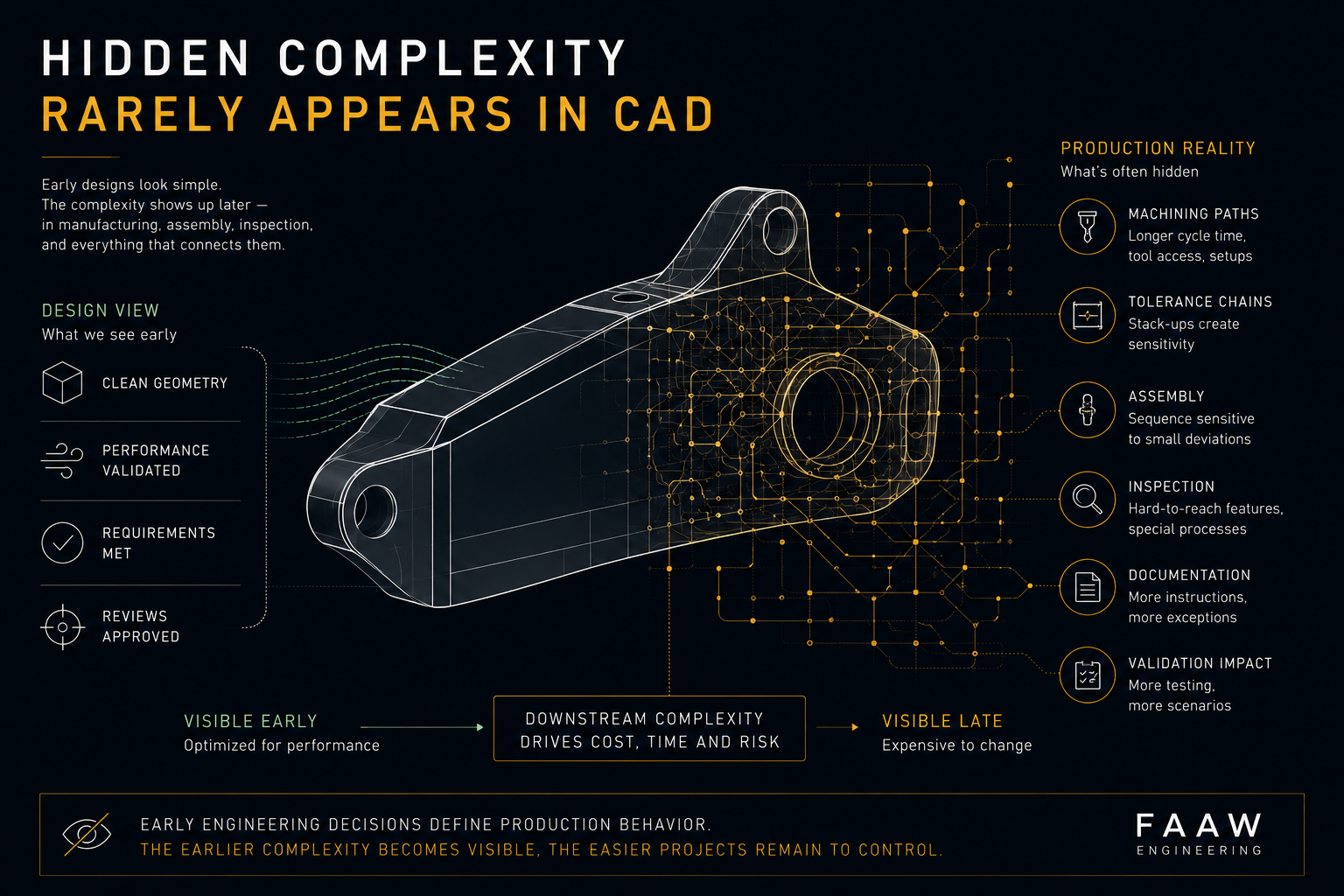
Some engineering designs look straightforward in CAD.
The geometry appears clean. Interfaces seem manageable. The system looks ready for production.
At this stage, everything may appear under control.
Then manufacturing starts asking questions.
Complexity is often introduced through small local decisions
In aerospace development, hidden complexity rarely comes from one major issue. More often, it develops gradually through:
- geometry that increases machining time
- tolerances tighter than functionally necessary
- assembly sequences sensitive to small deviations
- features difficult to inspect consistently
Individually, these decisions may seem insignificant. Together, they shape how stable the system becomes in production.
Early design reviews usually focus on system correctness
At early stages, reviews are typically centered around:
- functional behavior
- structural integrity
- aerodynamic performance
- integration at system level
This is necessary. But manufacturability constraints often become visible much later. A design can be technically correct and still introduce unnecessary downstream complexity.
We frequently observe a mismatch between global performance and local manufacturability
At system level, the design may still appear optimized. Locally, however:
- machining becomes inefficient
- tolerance chains become sensitive
- assembly repeatability decreases
- validation effort increases unexpectedly
These effects are rarely dominant during early simulations or CAD reviews.
Later, they directly affect:
- lead times
- production stability
- manufacturing cost
- schedule predictability
Complexity becomes expensive when it propagates through the project
Once production preparation begins, even small adjustments can affect:
- tooling
- documentation
- inspection procedures
- assembly workflows
- validation activities
At that point, the issue is no longer only technical. It becomes a coordination problem across the development lifecycle.
From our perspective, design quality is not defined only by correctness
We see the strongest engineering outcomes when design decisions also account for:
- manufacturability
- repeatability
- inspection stability
- downstream integration impact
This usually requires production constraints to become visible earlier in development.