Case Study
Laminate Mold Production Using Additive Printing
75% development time reduction and 40% cost savings
Project Context
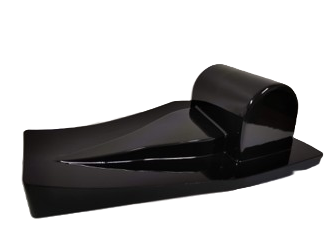
The client was developing a geometrically complex aerodynamic cover for a 50-piece series. A precise laminate mold was needed quickly for testing and subsequent small-series production.
Challenge
Challenge
Traditional CNC machining production had fundamental limitations. The mold became a critical development bottleneck.
- 8-week lead timeDelaying testing and the entire development cycle.
- High costsFive-axis milling, material waste.
- Low flexibilityDesign change = new mold + additional 2 months.
Solution
Additive Rapid Tooling from PA-CF
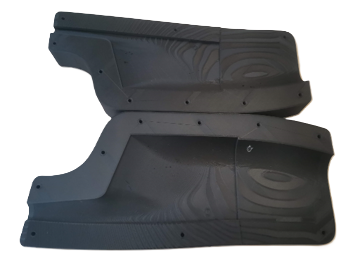
Instead of machining, we chose direct 3D printing of the mold from composite material with carbon fiber (Nylon-Carbon).
Key technical reasons
- Geometric freedomProduction of complex radii and shapes.
- Temperature resistance up to 120 °CSuitable for lamination and curing.
- CAM programming eliminationNo five-axis milling needed. The result was a one-piece mold without design compromises.
Implementation Process
Implementation Process
From CAD model optimization to geometry validation.
CAD Model Optimization
Adding internal ribs to increase rigidity.
Additive Manufacturing
Production on industrial equipment with emphasis on dimensional accuracy.
Surface Finish
Hand sanding and polishing of functional surfaces. Achieving quality for visible carbon.
3D Geometry Control
Validation against CAD model.
Results
Results Comparison
| Parameter | Traditional CNC | 3D Printing |
|---|---|---|
| Mold delivery | 8 weeks | 14 days |
| Costs | 100% | –40% |
| Change flexibility | Low | High |
Key Benefits
- 75% reduction in production cycle
- 40% cost reduction
- Ability to start lamination weeks earlier
- Elimination of technological risk when changing design
Conclusion
Conclusion
Prototype and small-series molds produced using 3D printing proved to be effective bridge tooling in this project. Mold production stopped being a critical development bottleneck and became a fast, predictable step.