Back to Insights
    Decision Layer5 min read

    Late-stage changes are rarely difficult because of engineering alone

    They become difficult because of timing.

    Early in development

    • changes are manageable
    • options remain open
    • system impact is limited

    Later in the project

    • testing has already started
    • documentation has reached high maturity
    • certification evidence is progressing
    • schedules become constrained

    Especially in CS-23 certification projects, this changes the nature of every modification.

    At that stage

    • proving compliance becomes more difficult
    • validation scope expands
    • even small changes propagate through the system
    • project cost increases disproportionately

    The technical solution itself may remain simple.

    The certification and project impact does not.
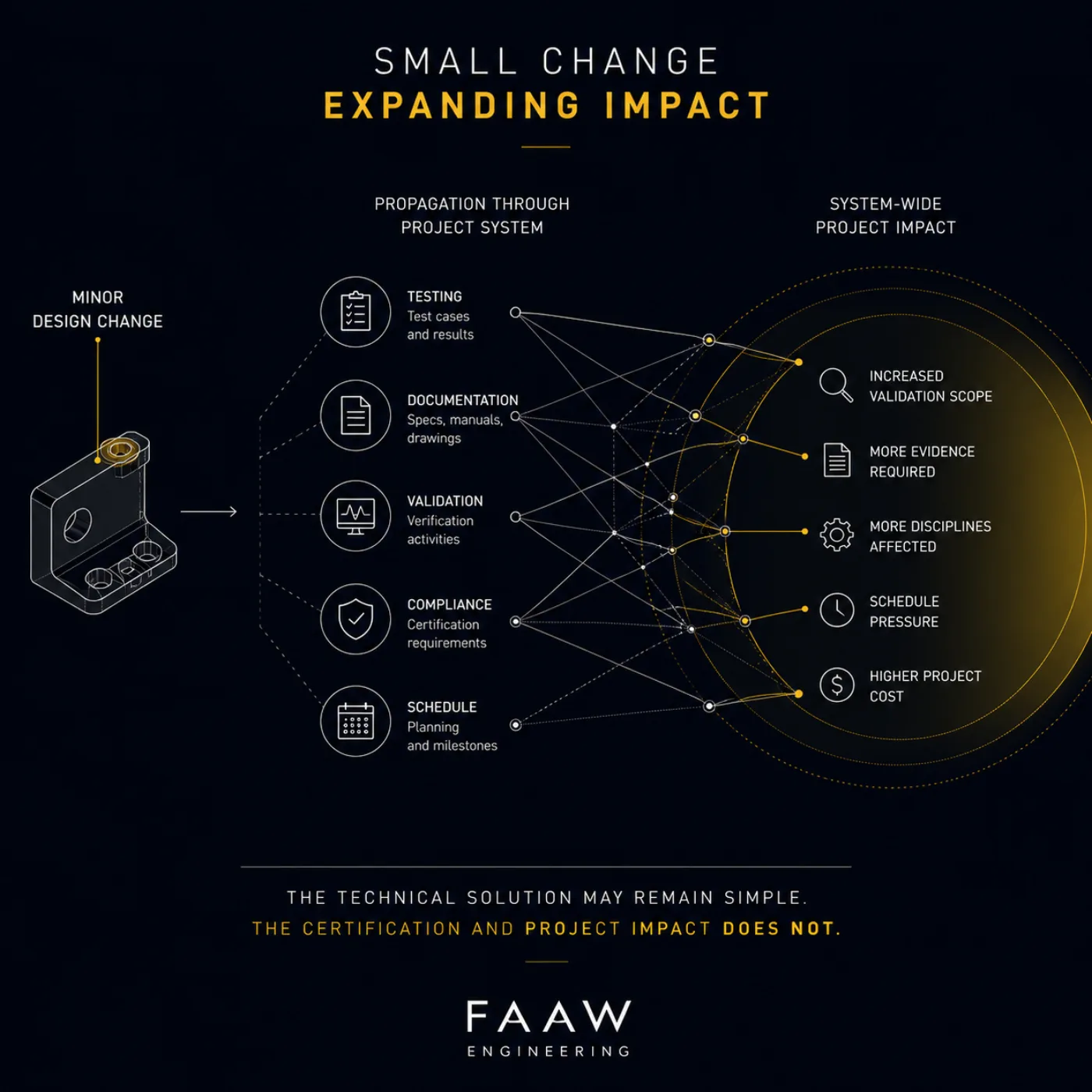
    Diagram showing a minor design change propagating through testing, documentation, validation, compliance and schedule, expanding into system-wide project impact
    A minor design change rarely stays minor — it propagates across the project system and expands into system-wide certification and cost impact.

    Engineering implication

    Change management is not only a design activity. It is a lifecycle coordination problem across development, validation, and certification.

    FAAW perspective

    Project control depends on how early critical constraints become visible across the full development cycle.